
Silver Price Crash: Why Silver Fell Below $45 and What It Means for Buyers in Pakistan
- Gold prices respond to global market uncertainty.
- Currency movement can affect local gold prices.
- Local demand, duties, and inflation may add pressure.
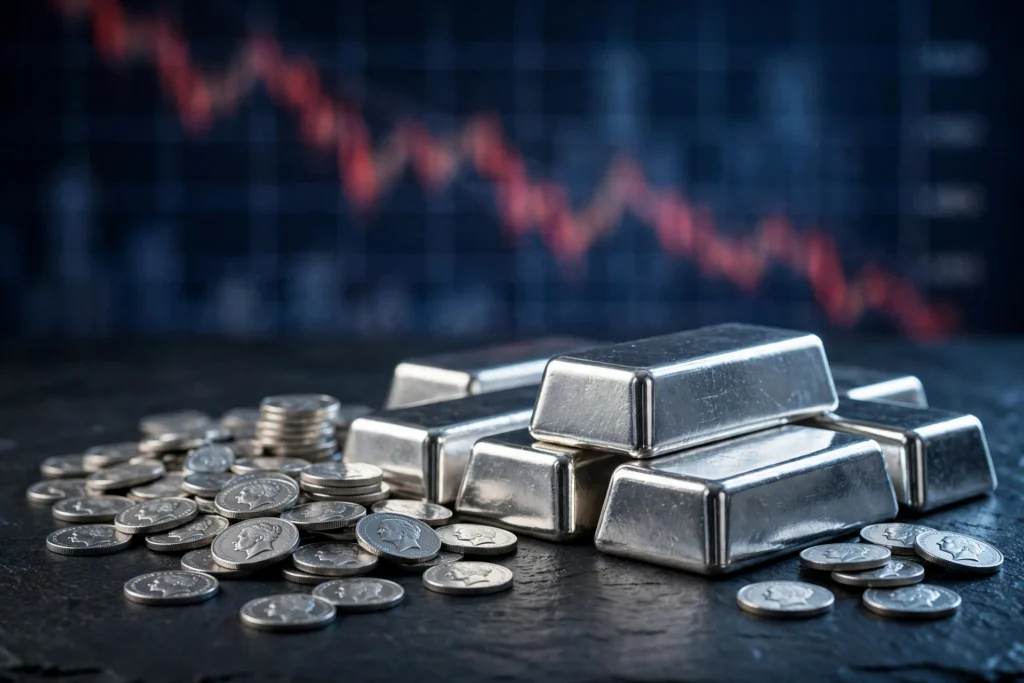
The silver price crash accelerated this week. On Wednesday, 18 November 2026, silver fell about 5% in a single session to trade below $45 an ounce for the first time since September 2025. It is now down roughly 20% in a month and more than 60% from its January record high — the hardest-hit major precious metal in a sell-off that has also pushed gold to a 14-month low.
The trigger is familiar: the US Federal Reserve looks increasingly likely to raise interest rates again in December, the dollar has climbed to its strongest level in 19 months, and investors are pulling money out of precious-metal funds.
Silver Price Today: The Latest Verified Numbers
Prices move fast in a sell-off, so every figure below carries its date, time and source.
| Market | Price | Change | As of | Source |
|---|---|---|---|---|
| Spot silver (XAG/USD) | $45.63 per troy ounce | +1.28% on the day | 19 Nov 2026, 00:28 UTC | Swissquote, via SilverPrice |
| Spot silver, Wednesday close | $45.03 per troy ounce | −5.0% on the day | 18 Nov 2026, afternoon | Reuters |
| Spot gold (XAU/USD) | ~$3,755 per troy ounce | +0.8% on the day | 19 Nov 2026, 08:52 Singapore time | The Business Times |
| Spot gold, Wednesday close | $3,726.19 per troy ounce | −3.2% on the day | 18 Nov 2026, afternoon | Reuters |
| USD to PKR (SBP) | Rs 276.55 per US dollar | Unchanged | 18 Nov 2026 (M2M Rs 276.5514) | State Bank of Pakistan |
| Silver in Pakistan | ~Rs 4,737 per tola | Converted reference rate | 19 Nov 2026 | SilverPrice (spot conversion) |
| Gold in Pakistan (24K) | Rs 400,884 per tola | +Rs 1,638 on the day | 19 Nov 2026 | PakGold (Sarafa benchmark) |
Silver steadied slightly on Thursday morning, recovering about 1.3% from Wednesday’s close. But that small bounce changes little: silver is down about 9–10% in the past week and roughly 20% in the past month, after trading near $57.34 an ounce a month ago.
What Happened on Wednesday: A 5% Drop in One Session
Wednesday, 18 November, was the worst day of the current sell-off. Reuters’ afternoon update put spot silver down 5% at $45.03 an ounce, platinum down 4.1% to $1,370.70, and copper down 5% on the London Metal Exchange to its lowest since early April. Gold fell 3.2% to $3,726.19, touching an intraday low of $3,719.55 — its lowest close since September 2025.
It was not a one-day event. In India, silver had already fallen 5.3% on Tuesday, 17 November, to Rs 1,69,500 per kilogram — a one-year low — after shedding Rs 25,000, or about 13%, in just eight trading sessions since 5 November, according to the Press Trust of India.
Why Silver Is Falling
The Fed is expected to raise rates again in December. Minutes of the Fed’s previous policy meeting, released on Wednesday, 18 November, showed that nearly all officials believed interest rates would have to rise in the months ahead to bring inflation back to the Fed’s 2% target. Markets now price in roughly a 96% probability of a 25-basis-point hike at the Fed’s 9 December meeting, according to CME FedWatch data reported on the morning of 18 November. The current federal funds target range is 3.75% to 4.00%. Higher rates hurt precious metals because gold and silver pay no interest — when rates rise, holding metal becomes more expensive in opportunity-cost terms.
The dollar is at a 19-month high. The US dollar index rose to 103.43, its highest level in 19 months. A stronger dollar makes silver more expensive for buyers using other currencies and tends to push dollar-priced commodities lower across the board.
Investors are pulling money out of silver funds. Silver-focused exchange-traded funds held about 1.25 billion ounces in early November, down 4% from the start of January, according to data cited by Kitco News. Research firm Metals Focus expects a net outflow of 45 million ounces by the end of 2026, after a record inflow of 278 million ounces in 2025.
Industrial demand is cooling. Unlike gold, more than half of silver demand comes from industry — solar panels, electronics and cars. The Silver Institute expects demand for silver from the solar sector to fall 19% in 2026, a record decline, removing a key support just as investment demand fades.
A burst bubble is unwinding. After a 147% rally in 2025, silver gained another 70% at the start of 2026 before the bubble burst around the end of January. The latest drop looks like forced selling: as prices fall, leveraged traders face margin calls and must sell, pushing prices lower still.
Silver vs Gold: The White Metal Is Falling Faster
Gold and silver usually move together, but silver moves further in both directions. Over the past month silver has fallen about 20–21%, while gold has fallen about 9.5%. Platinum is down about 17% and palladium about 15% over the same period.
Gold is down more than 34% from its record high of close to $5,600 an ounce earlier this year. Silver has fallen even further from its peak: it is now more than 60% below its January 2026 record high of about $117 an ounce.
Silver Price in Pakistan: What Buyers Should Know
For Pakistani buyers, the international crash is only half the story. The rupee has been unusually steady — the State Bank of Pakistan’s mark-to-market rate was Rs 276.5514 on 18 November, effectively unchanged — so the drop in dollar prices is passing through to local rates almost in full.
Silver in Pakistan is trading at around Rs 4,737 per tola, based on the international spot price converted at the current exchange rate. That is a converted reference figure, not a sarafa shop quote: local jewellers add making charges, premiums and taxes, so the price you are quoted in a shop will be higher.
- Jewellery buyers are getting a genuine discount compared with a month ago: silver jewellery and household silverware cost roughly a fifth less in dollar terms than they did in mid-October.
- Investors should remember that silver is far more volatile than gold. A metal that can fall 5% in a day can also bounce sharply, and the same forces that drove it down can reverse quickly if US inflation data surprises on the soft side.
- Sellers should check the live rate before dealing. Sarafa rates in Pakistan are set daily, and in a fast-moving market the morning quote can be out of date by the afternoon.
International Comparison: The Sell-Off Is Global
The crash is not limited to London and New York. In India, silver fell 5.3% on 17 November to Rs 1,69,500 per kilogram, its lowest in a year, while gold fell for a sixth straight session to Rs 1,38,600 per 10 grams, according to the All India Sarafa Association.
One factor still supports silver over the longer term: the Silver Institute forecasts the global silver market will record a sixth consecutive year of supply deficit in 2026, at around 35 million ounces — narrower than the 54-million-ounce deficit of 2025, but a deficit nonetheless. A market in deficit does not stay cheap forever, but deficits do not stop prices falling while investors are selling.
What Could Happen Next?
Nobody can call the bottom of a sell-off with confidence, and this article does not try. What the evidence suggests is a market caught between two forces.
On the bearish side, the near-term drivers all point the same way. The Fed is widely expected to hike on 9 December, the dollar is at a 19-month high, fund outflows are continuing, and silver has broken below support at $45.50 that had held since late October 2025. Analysts watching the charts put the next supports near $41.50 and $36.20.
On the other side, silver is deeply oversold by most measures, more than 60% below its January peak, and the physical market remains in deficit for a sixth straight year. Wednesday’s selling had the hallmarks of forced liquidation rather than a calm reassessment of value.
The next real test comes with US economic data. The final University of Michigan consumer sentiment survey is due on Friday, 20 November, and the October PCE inflation report — the Fed’s preferred inflation measure — is due on Wednesday, 25 November. Softer-than-expected inflation would ease hike expectations and could give both gold and silver room to recover. Hotter data would do the opposite.
Frequently Asked Questions
Why did the silver price crash?
Silver fell about 5% on 18 November 2026 to below $45 an ounce after the Federal Reserve’s meeting minutes showed nearly all officials expect interest rates to rise further. Markets now price in a roughly 96% chance of a December rate hike, the dollar hit a 19-month high, and investors pulled money out of silver funds.
What is the silver price today?
Spot silver was trading at about $45.63 per troy ounce on 19 November 2026 at 00:28 UTC, up about 1.3% from Wednesday’s close, according to Swissquote data. Prices move during the day, so check FXMora’s live rates before buying or selling.
What is the silver rate in Pakistan today?
Silver in Pakistan is around Rs 4,737 per tola on 19 November 2026, based on the international spot price converted at the State Bank of Pakistan’s rate of about Rs 276.55 per US dollar. Local shop prices will be higher because jewellers add making charges and premiums.
Will silver prices go up or down next?
That depends mainly on the Federal Reserve’s 9 December decision and US inflation data due on 25 November. If inflation comes in softer than expected, rate-hike expectations could ease and silver could recover. If inflation stays hot, the dollar is likely to stay strong and silver could test lower support near $41.50 an ounce.
Conclusion
The silver price crash of November 2026 is a textbook case of how fast sentiment can turn in precious metals. A metal that gained 147% in 2025 and hit record highs in January has now lost more than 60% of its peak value.
For buyers in Pakistan, the crash brings silver to its cheapest level in more than a year, with a steady rupee passing the full benefit of lower dollar prices through to local rates. For investors, the lesson is silver’s double nature: it is both a monetary metal and an industrial one, so it falls harder than gold when rates rise and industrial demand cools — and it can rebound just as sharply when conditions change.
Sources and References
- Reuters, via FXNews — “Gold falls 3.2% as silver and platinum suffer steeper losses,” 18 Nov 2026.
- Kitco News — “As silver underperforms gold, has its bubble popped?” 18 Nov 2026.
- The Business Times — “Gold rises from 14-month low as dip buying offsets hawkish Fed,” 19 Nov 2026.
- CNBC TV18, via TradingView — Gold market report, 19 Nov 2026.
- BullionTree — “CME FedWatch Signals a December Rate Hike,” 18 Nov 2026.
- News18 — “Gold Falls To 14-Month Low; Silver & Copper Prices Crash,” 19 Nov 2026.
- ActionForex — “Silver Is Sinking,” 19 Nov 2026.
- BeInCrypto — “Silver Price Erased 45 Years of Gains. Will It Crash Further?” 18 Nov 2026.
- Stockbiz — “Silver prices plunge more than 5%, retreat to $50 per ounce,” 16 Nov 2026.
- Press Trust of India, via Swadesi — 17 Nov 2026.
- SilverPrice / Swissquote — Spot silver $45.63, 19 Nov 2026, 00:28 UTC.
- BullionVault — Live silver price $45.44, 19 Nov 2026, 02:12 GMT.
- State Bank of Pakistan — M2M rate Rs 276.5514, 18 Nov 2026.
- PakGold — 24K gold Rs 400,884 per tola, 19 Nov 2026.
This content is for informational and educational purposes only and should not be considered financial or investment advice.